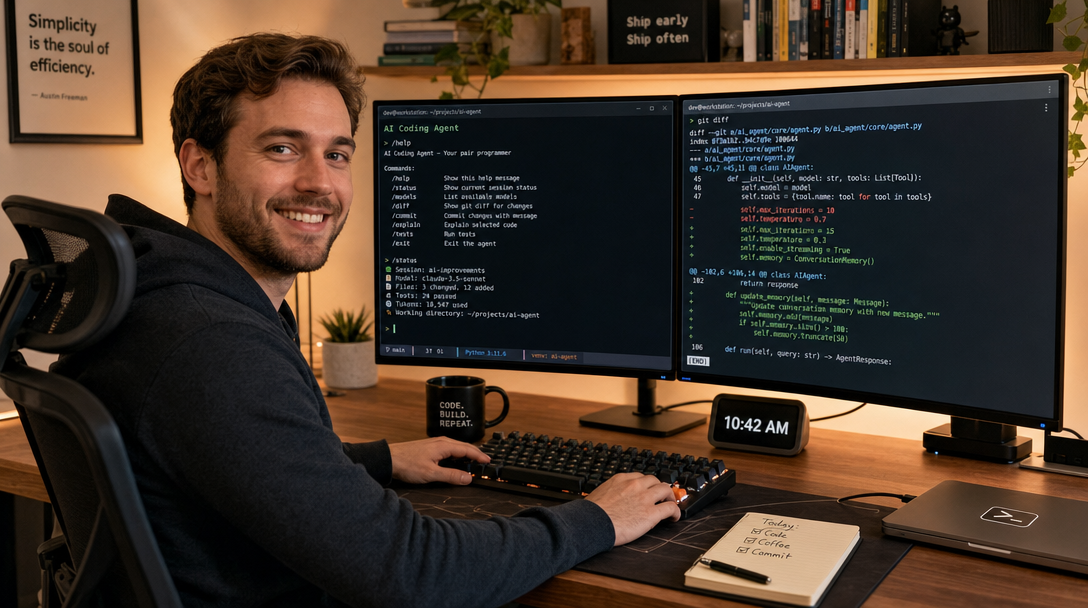
The choice between opencode vs claude code represents two fundamentally different philosophies in modern terminal-based AI software engineering. While both tools operate directly inside your command-line interface to edit codebases, run unit tests, and resolve Git issues autonomously, they diverge sharply in their backend architecture, model flexibility, and data privacy models. Use OpenCode if you require total model freedom, local offline inference via Ollama or vLLM, and strict open-source licensing; use Claude Code if you want cutting-edge agentic reasoning out of the box powered directly by Anthropic’s Claude 3.7 Sonnet and hybrid thinking models.
Quick Verdict: When to Choose Which Tool
- Choose OpenCode if: You want a community-driven, open-source terminal agent that connects to any provider (Ollama, vLLM, DeepSeek, OpenAI, Groq, or self-hosted API gateways). It is ideal for privacy-sensitive enterprises, air-gapped homelabs, and developers who refuse proprietary vendor lock-in.
- Choose Claude Code if: You want the highest possible autonomous reasoning quality for complex multi-file refactoring, deep architectural debugging, and automated test-driven development. Because it is engineered specifically for Anthropic’s Claude models, its prompt caching, context management, and sub-agent workflows feel exceptionally cohesive.
Feature Comparison: OpenCode vs Claude Code
Here is how the two terminal AI coding assistants compare across core architectural dimensions as of November 2026:
| Feature | OpenCode | Claude Code |
|---|---|---|
| Developer & License | Open Source (Community Driven) | Proprietary CLI (Anthropic) |
| Primary Backend Model | Any (Ollama, DeepSeek-V3, Qwen 2.5, OpenAI) | Claude 3.7 Sonnet / Opus (Anthropic API) |
| Local Offline Execution | Yes (Full support for local GGUF/vLLM) | No (Requires active Anthropic API / Cloud) |
| Terminal & Bash Tooling | Native CLI commands & customizable tool plugins | Built-in bash execution, ripgrep, file edits |
| Model Context Protocol (MCP) | Extensible via custom agent configurations | Native built-in MCP server integration |
| Cost Model | Free CLI + your own API / compute costs | Per-token billing via Anthropic Console / Bedrock |
| Data Sovereignty | Complete (Data never leaves local host when using Ollama) | Commercial Cloud (Subject to Anthropic API privacy policies) |
Key Differences in Detail
1. Backend Flexibility vs Tailored Intelligence
The defining technical distinction between the two agents is backend coupling. Claude Code is an opinionated client purpose-built around Anthropic’s frontier LLMs. It leverages prompt caching heavily, reducing repetitive input token billing when inspecting large code repositories. The reasoning depth provided by Claude 3.7 Sonnet’s extended thinking capabilities allows it to plan multi-step refactors across hundreds of lines of code with minimal hallucination.
Conversely, OpenCode acts as an open protocol and multi-provider agent. It does not dictate which model you run. If you want to use DeepSeek-Coder-V2 for cost efficiency, switch to an open-weight Qwen model for local processing, or connect to a private endpoint hosted on your local network, OpenCode accommodates standard OpenAI-compatible endpoints seamlessly.
2. Privacy, Telemetry, and Data Governance
For enterprise developers working under strict NDA, healthcare compliance, or GDPR constraints, sending proprietary intellectual property over external APIs is often prohibited. While Anthropic states that data sent to its commercial API is not used to train generative models, the code payloads still traverse external cloud infrastructure.
OpenCode eliminates this compliance hurdle completely when paired with an on-premises inference server. By routing OpenCode requests through a local model runner, no source code, environment secrets, or proprietary database schemas ever leave your machine’s physical RAM and GPU memory. If you are exploring self-hosted AI alternatives for your local IDE, take a look at our companion guide on how to self-host Continue.dev with Ollama and Qwen in Docker Compose.
3. Tool Execution and Context Management
Both assistants transcend traditional chat web UIs by executing real developer operations inside your repository directory:
- File Search and Reading: Both tools use high-performance indexers (such as ripgrep) to pinpoint function definitions and call sites without blindly dumping your entire repository into context memory.
- Diff Application: Claude Code uses structured patch blocks and verifies that unit tests pass before asking for user approval. OpenCode offers flexible diffing modes that allow granular approval for each file modification.
- Protocol Extensions: Both environments can leverage external data sources and tools. To understand how external services integrate with autonomous agents via standardized protocols, check out our in-depth explainer on what is an MCP server and what you can do with it.
4. Operational Costs and Token Economics
Terminal coding agents consume vastly more tokens than standard conversational interfaces because every file inspection, directory tree walk, and compiler output is appended to the session context. In an active workday, running Claude Code on a medium-to-large repository can easily consume millions of tokens, leading to noticeable API charges on Anthropic accounts.
OpenCode offers a predictable cost ceiling: once you invest in capable local hardware (such as workstation GPUs with sufficient VRAM), running local coding models incurs zero incremental token fees. Furthermore, developers can pair OpenCode with high-throughput containerized inference engines. To discover how containerized inference handles concurrent workloads, read our tutorial on how to run Model Context Protocol servers in Docker with Ollama.
Workflow Example: Debugging a Failing Test Suite
To visualize the operational difference, consider a scenario where a database migration script fails during an integration test:
With Claude Code:
# Launch Claude Code in your project root
claude

# Prompt the agent directly
> Run pytest tests/test_migrations.py, inspect the failure trace, and fix the SQL schema
Claude Code executes the test runner in a subshell, captures the traceback, reads the relevant migration file, crafts a surgical code edit, re-runs the pytest command to verify success, and presents a concise git diff for your final approval.
With OpenCode:
# Launch OpenCode configured with a local Ollama endpoint
opencode --model ollama/qwen2.5-coder:32b

# Provide the task
> pytest tests/test_migrations.py failed with exit code 1. Check the logs and update the migration
OpenCode performs a similar loop, parsing the bash output and updating files locally. However, performance and reasoning accuracy will depend directly on the parameter size and quantization of your underlying local model.
Recommendation per Use Case
Your team’s technical constraints should dictate your selection:
- High-Velocity Startups & Commercial Software Teams: Use Claude Code. The superior reasoning capabilities of Claude 3.7 Sonnet drastically reduce the time spent steering the AI or correcting flawed logic, easily justifying the API costs in saved engineering hours.
- Security-Sensitive Enterprises, Homelabs & FOSS Purists: Use OpenCode. The architectural freedom to point the agent to local models, custom fine-tunes, or sovereign private cloud instances ensures complete privacy and zero vendor lock-in.
Frequently Asked Questions (FAQ)
Can I use Claude Code with local Ollama models?
Officially, Claude Code is designed exclusively to interface with Anthropic’s Claude models via the Anthropic API or Amazon Bedrock / Google Cloud Vertex AI. While community proxies and router shims exist to intercept API calls and redirect them to local endpoints, native multi-model support is not an architectural priority for Anthropic’s official client.
Is OpenCode completely free to use?
Yes, OpenCode itself is distributed as free, open-source software under permissive licenses. However, while the software client has no subscription fee, you must either provide your own hardware compute to run local models (via Ollama or vLLM) or pay standard third-party per-token API rates if you choose to connect OpenCode to cloud providers like DeepSeek, OpenAI, or Groq.
How do context limits affect long coding sessions?
Both tools manage context truncation automatically. Claude Code benefits from Anthropic’s 200,000-token context window and aggressive server-side prompt caching, enabling it to remember earlier decisions across prolonged sessions. In OpenCode, the effective context limit is determined by your chosen model backend and available GPU VRAM.

Hi, I’m Mark, the author of Clever IT Solutions: Mastering Technology for Success. I am passionate about empowering individuals to navigate the ever-changing world of information technology. With years of experience in the industry, I have honed my skills and knowledge to share with you. At Clever IT Solutions, we are dedicated to teaching you how to tackle any IT challenge, helping you stay ahead in today’s digital world. From troubleshooting common issues to mastering complex technologies, I am here to guide you every step of the way. Join me on this journey as we unlock the secrets to IT success.