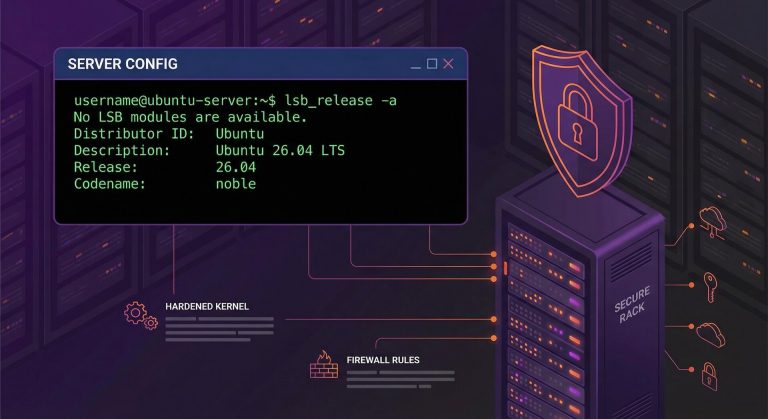
Securing your Linux server is essential in today’s threat landscape. This comprehensive linux server security hardening guide covers every critical step to protect your system from attacks, unauthorized access, and data breaches. Whether you manage a VPS, dedicated server, or cloud instance, implementing these security measures will significantly reduce your attack surface.
Linux servers face constant threats from automated bots, brute-force attacks, and sophisticated intruders. By following this tutorial, you will learn industry-standard hardening techniques used by security professionals worldwide. The methods described here apply to Ubuntu, Debian, CentOS, RHEL, and most other Linux distributions.
Why Linux Server Security Hardening Matters
Every Linux server connected to the internet becomes a target within minutes of going online. Automated scanning tools continuously search for vulnerable systems, attempting to exploit weak passwords, outdated software, and misconfigured services. Implementing proper linux server security hardening measures creates multiple layers of defense that deter attackers and protect your data.
The consequences of a compromised server can be severe: data theft, cryptocurrency mining, DDoS attacks launched from your infrastructure, or complete system destruction. Proactive hardening is always more effective and less expensive than responding to a security incident after it occurs.
Initial Security Assessment
Before implementing hardening measures, assess your current security posture:
# Check currently running services
systemctl list-units --type=service --state=running

# Review open network connections
ss -tunap

# List all user accounts
cat /etc/passwd

# Check for unnecessary SUID binaries
find / -perm -4000 -type f 2>/dev/null
Document your findings to establish a baseline and track improvements as you implement security measures.
SSH Security Configuration
SSH is the most frequently attacked service on Linux servers. Proper configuration eliminates the most common attack vectors:
Disable Root Login
Prevent direct root access via SSH by editing the configuration file:
sudo nano /etc/ssh/sshd_config
Add or modify these settings:
PermitRootLogin no
PasswordAuthentication no
PubkeyAuthentication yes
AllowUsers yourusername
MaxAuthTries 3
MaxSessions 3
These settings prevent root login, disable password authentication in favor of SSH keys, restrict access to specific users, and limit authentication attempts.
Use Strong SSH Ciphers
Enhance cryptographic security by specifying strong algorithms:
Ciphers chacha20-poly1305@openssh.com,aes256-gcm@openssh.com
MACs hmac-sha2-512-etm@openssh.com,hmac-sha2-256-etm@openssh.com
KexAlgorithms curve25519-sha256@libssh.org,diffie-hellman-group16-sha512
Change Default SSH Port
While security through obscurity is not a complete solution, changing the default SSH port reduces automated attack noise:
Port 2222
Remember to update your firewall rules after changing the port.
Restart SSH Service
Apply the changes:
sudo systemctl restart sshd
Important: Before disconnecting, open a new terminal and verify you can still connect with your new settings.
Firewall Configuration with UFW
UFW (Uncomplicated Firewall) provides an intuitive interface for managing iptables rules on Ubuntu and Debian systems:
Basic UFW Setup
# Install UFW if not present
sudo apt install ufw -y

# Set default policies
sudo ufw default deny incoming
sudo ufw default allow outgoing

# Allow SSH (adjust port if changed)
sudo ufw allow 2222/tcp

# Allow HTTP and HTTPS if running a web server
sudo ufw allow 80/tcp
sudo ufw allow 443/tcp

# Enable the firewall
sudo ufw enable
Advanced UFW Rules
Restrict access to specific IP addresses for administrative services:
# Allow SSH only from specific IP
sudo ufw allow from 192.168.1.100 to any port 2222

# Allow access to a specific port range
sudo ufw allow 1000:2000/tcp
Kernel and Network Hardening
System-level hardening protects against network-based attacks and kernel exploits:
Sysctl Security Parameters
Create a hardening configuration file:
sudo nano /etc/sysctl.d/99-security.conf
Add these security parameters:
# IP Spoofing protection
net.ipv4.conf.all.rp_filter = 1
net.ipv4.conf.default.rp_filter = 1

# Disable IP source routing
net.ipv4.conf.all.accept_source_route = 0
net.ipv6.conf.all.accept_source_route = 0

# Disable ICMP redirects
net.ipv4.conf.all.accept_redirects = 0
net.ipv4.conf.default.accept_redirects = 0

# SYN flood protection
net.ipv4.tcp_syncookies = 1
net.ipv4.tcp_max_syn_backlog = 2048
net.ipv4.tcp_synack_retries = 2
net.ipv4.tcp_syn_retries = 5

# Disable IPv6 if not needed
net.ipv6.conf.all.disable_ipv6 = 1
net.ipv6.conf.default.disable_ipv6 = 1

# Enable ASLR
kernel.randomize_va_space = 2

# Increase system file descriptor limit
fs.file-max = 65535
Apply the settings:
sudo sysctl --system
Fail2Ban Intrusion Prevention
Fail2Ban monitors log files and bans IP addresses showing malicious patterns:
Installation and Configuration
# Install Fail2Ban
sudo apt install fail2ban -y

# Create local configuration
sudo cp /etc/fail2ban/jail.conf /etc/fail2ban/jail.local
sudo nano /etc/fail2ban/jail.local
Configure SSH protection:
[sshd]
enabled = true
port = 2222
filter = sshd
logpath = /var/log/auth.log
maxretry = 3
bantime = 3600
findtime = 600
Start the service:
sudo systemctl enable fail2ban
sudo systemctl start fail2ban
Automatic Security Updates
Enable automatic installation of security patches:
# Install unattended-upgrades
sudo apt install unattended-upgrades -y

# Configure
sudo dpkg-reconfigure --priority=low unattended-upgrades
Review the configuration in /etc/apt/apt.conf.d/50unattended-upgrades to ensure only security updates are applied automatically.
User Account Security
Implement Principle of Least Privilege
Review and restrict sudo access:
sudo visudo
Avoid blanket NOPASSWD: ALL entries. Instead, grant specific permissions:
username ALL=(ALL:ALL) /usr/bin/apt, /bin/systemctl restart nginx
Remove Unnecessary Accounts
Disable or remove unused system accounts:
# List all users
cut -d: -f1 /etc/passwd

# Disable a user
sudo usermod -s /sbin/nologin username

# Or delete entirely
sudo userdel -r username
File Integrity Monitoring with AIDE
AIDE (Advanced Intrusion Detection Environment) monitors file system changes:
# Install AIDE
sudo apt install aide -y

# Initialize the database
sudo aideinit

# Move the new database into place
sudo mv /var/lib/aide/aide.db.new /var/lib/aide/aide.db
Schedule regular checks via cron:
# Run daily check
0 3 * * * /usr/bin/aide --check
Service and Process Hardening
Disable Unnecessary Services
# List enabled services
systemctl list-unit-files --state=enabled

# Disable unused services
sudo systemctl disable service_name
sudo systemctl stop service_name
Review SUID and SGID Binaries
Minimize SUID binaries to reduce privilege escalation risks:
find / -perm -4000 -type f 2>/dev/null
Remove SUID bit from unnecessary binaries:
sudo chmod u-s /path/to/binary
Security Monitoring and Logging
Centralized Logging
Configure rsyslog for centralized log management:
sudo nano /etc/rsyslog.conf
Log Analysis with Logwatch
sudo apt install logwatch -y
sudo logwatch --detail high --range today
For modern, low-overhead kernel-level inspection and real-time observability, see our tutorial on eBPF Linux monitoring and system observability.
Backup and Recovery Strategy
Security hardening includes preparing for worst-case scenarios:
- Implement automated daily backups
- Store backups in geographically separate locations
- Test restoration procedures regularly
- Document recovery processes
- Maintain offline copies of critical data
Security Verification and Testing
After implementing linux server security hardening measures, verify your configuration:
# Check for open ports
nmap -sT -O localhost

# Audit SSH configuration
ssh-audit localhost

# Review system logs for anomalies
sudo journalctl -xe | grep -i "failed\|error\|attack"
Consider using security scanning tools like Lynis for comprehensive auditing:
sudo apt install lynis -y
sudo lynis audit system
Conclusion
This linux server security hardening guide has covered essential techniques to protect your Linux server from common threats. From SSH hardening and firewall configuration to kernel parameters and intrusion detection, implementing these measures creates a robust security foundation.
Remember that security is an ongoing process, not a one-time configuration. Regularly review logs, update software, audit user accounts, and stay informed about new vulnerabilities affecting your systems. By maintaining vigilance and following security best practices, you will keep your Linux servers secure against evolving threats.
For more Linux administration tutorials and security guides, explore our comprehensive collection of system administration resources.

Hi, I’m Mark, the author of Clever IT Solutions: Mastering Technology for Success. I am passionate about empowering individuals to navigate the ever-changing world of information technology. With years of experience in the industry, I have honed my skills and knowledge to share with you. At Clever IT Solutions, we are dedicated to teaching you how to tackle any IT challenge, helping you stay ahead in today’s digital world. From troubleshooting common issues to mastering complex technologies, I am here to guide you every step of the way. Join me on this journey as we unlock the secrets to IT success.