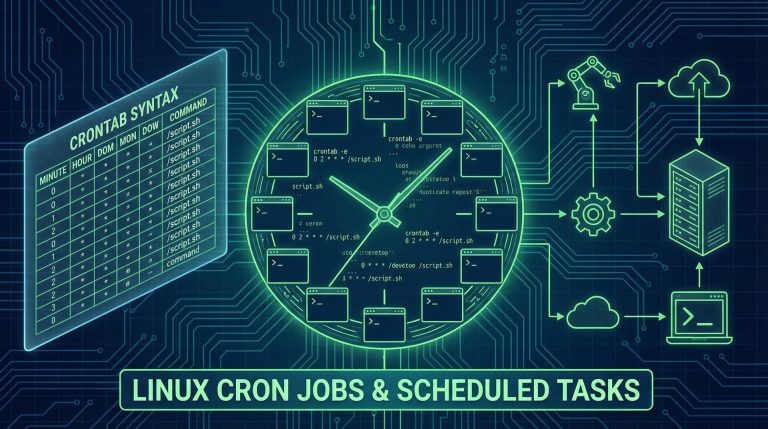
If you want to automate Linux tasks bash scripts and cron jobs can transform your workflow from manual to efficient. This comprehensive guide shows you exactly how to automate Linux tasks bash scripts and schedule them with cron for maximum productivity.
Why Automate Linux Tasks with Bash Scripts?
System administrators and developers know that repetitive tasks consume valuable time. When you automate Linux tasks bash scripts eliminate manual work and reduce human error. Bash scripting combined with cron scheduling creates powerful automation solutions for:
- System backups and maintenance
- Log file rotation and cleanup
- Database dumps and migrations
- Monitoring and alerting systems
- Automated deployments and updates
- Report generation and data processing
According to Red Hat’s automation research, organizations that automate routine tasks save an average of 20-30 hours per week per administrator.
Understanding Bash Scripts Fundamentals
Before you can effectively automate Linux tasks bash scripts require understanding core concepts. A bash script is a text file containing a series of commands that the bash shell executes sequentially.
Creating Your First Bash Script
Every bash script starts with a shebang line that tells Linux which interpreter to use. Here’s a basic example to automate Linux tasks bash scripts style:
#!/bin/bash
# Simple backup script

BACKUP_DIR="/home/backup"
SOURCE_DIR="/var/www/html"
DATE=$(date +%Y-%m-%d-%H-%M-%S)

tar -czf "$BACKUP_DIR/website-$DATE.tar.gz" "$SOURCE_DIR"
echo "Backup completed: website-$DATE.tar.gz"
Make the script executable with chmod +x backup.sh. This foundation helps you automate Linux tasks bash scripts for any repetitive operation.
Essential Bash Scripting Techniques
To automate Linux tasks bash scripts effectively, master these techniques:
Variables and Parameter Expansion: Store values for reuse and dynamic operations. Use ${VARIABLE} syntax for clarity and $1, $2 for command-line arguments.
Conditional Logic: Implement decision-making with if-then-else statements. Check file existence, compare values, and handle different scenarios:
#!/bin/bash
if [ -f "/var/log/app.log" ]; then
    echo "Log file exists, proceeding with rotation"
    mv /var/log/app.log /var/log/app.log.old
else
    echo "No log file found"
fi
Loops for Batch Processing: Process multiple files or perform repeated operations. For loops excel at batch tasks when you automate Linux tasks bash scripts:
#!/bin/bash
for file in /tmp/*.log; do
    if [ -f "$file" ]; then
        gzip "$file"
        echo "Compressed: $file"
    fi
done
Functions for Reusability: Define functions to organize code and avoid repetition:
#!/bin/bash
cleanup_old_files() {
    local target_dir=$1
    local days=$2
    find "$target_dir" -type f -mtime +"$days" -delete
    echo "Cleaned files older than $days days from $target_dir"
}

cleanup_old_files "/var/log" 30
cleanup_old_files "/tmp" 7
The official Bash manual provides comprehensive documentation for advanced techniques.
Cron Jobs: Scheduling Automation
Once you’ve written scripts to automate Linux tasks bash scripts need scheduling. Cron is Linux’s built-in task scheduler that runs commands at specified times and intervals.
Cron Syntax Explained
Cron uses a five-field time specification followed by the command to execute:
# Cron format:
# ┌───────────── minute (0-59)
# │ ┌───────────── hour (0-23)
# │ │ ┌───────────── day of month (1-31)
# │ │ │ ┌───────────── month (1-12)
# │ │ │ │ ┌───────────── day of week (0-6, Sunday=0)
# │ │ │ │ │
# * * * * * command to execute
Common cron schedule examples to automate Linux tasks bash scripts:
0 2 * * *– Daily at 2:00 AM*/15 * * * *– Every 15 minutes0 0 * * 0– Weekly on Sunday midnight0 3 1 * *– Monthly on the 1st at 3:00 AM30 4 * * 1-5– Weekdays at 4:30 AM
Setting Up Cron Jobs
Edit your crontab with crontab -e. Here’s how to automate Linux tasks bash scripts with practical cron entries:
# Database backup every night at 2 AM
0 2 * * * /home/scripts/backup-database.sh >> /var/log/backup.log 2>&1

# Clean temporary files every 6 hours
0 */6 * * * /home/scripts/cleanup-temp.sh

# System health check every 15 minutes
*/15 * * * * /home/scripts/health-check.sh

# Weekly report generation Sunday at midnight
0 0 * * 0 /home/scripts/generate-weekly-report.sh
Important: Always redirect output with >> logfile 2>&1 to capture both standard output and errors. Cron runs in a minimal environment, so specify full paths to scripts and commands.
Environment Variables in Cron
Cron executes with a limited environment. Set variables at the top of your crontab to automate Linux tasks bash scripts reliably:
SHELL=/bin/bash
PATH=/usr/local/sbin:/usr/local/bin:/sbin:/bin:/usr/sbin:/usr/bin
MAILTO=admin@example.com

0 2 * * * /home/scripts/backup.sh
The MAILTO variable sends cron output via email, useful for monitoring automated tasks.
Real-World Automation Examples
Let’s explore practical scenarios where you can automate Linux tasks bash scripts and cron jobs together.
Example 1: Automated Backup System
This script creates incremental backups with rotation to automate Linux tasks bash scripts for data protection:
#!/bin/bash
# /home/scripts/intelligent-backup.sh

BACKUP_SOURCE="/var/www"
BACKUP_DEST="/backup/www"
MAX_BACKUPS=7
DATE=$(date +%Y-%m-%d)
LOGFILE="/var/log/backup.log"

echo "[$(date)] Starting backup" >> "$LOGFILE"

# Create backup
tar -czf "$BACKUP_DEST/www-$DATE.tar.gz" "$BACKUP_SOURCE" 2>> "$LOGFILE"

if [ $? -eq 0 ]; then
    echo "[$(date)] Backup successful: www-$DATE.tar.gz" >> "$LOGFILE"

    # Rotate old backups
    cd "$BACKUP_DEST"
    ls -t www-*.tar.gz | tail -n +$((MAX_BACKUPS + 1)) | xargs -r rm
    echo "[$(date)] Rotation complete, kept $MAX_BACKUPS backups" >> "$LOGFILE"
else
    echo "[$(date)] ERROR: Backup failed" >> "$LOGFILE"
    exit 1
fi
Crontab entry for nightly backups:
0 3 * * * /home/scripts/intelligent-backup.shExample 2: System Monitoring and Alerts
Monitor disk space and send alerts when you automate Linux tasks bash scripts for proactive management:
#!/bin/bash
# /home/scripts/disk-monitor.sh

THRESHOLD=80
EMAIL="admin@example.com"

df -H | grep -vE '^Filesystem|tmpfs|cdrom' | awk '{ print $5 " " $1 }' | while read output;
do
    usage=$(echo $output | awk '{ print $1}' | cut -d'%' -f1)
    partition=$(echo $output | awk '{ print $2 }')

    if [ $usage -ge $THRESHOLD ]; then
        echo "ALERT: Partition $partition is ${usage}% full on $(hostname)" | \
            mail -s "Disk Space Alert: $partition" "$EMAIL"
    fi
done
Run every hour with cron:
0 * * * * /home/scripts/disk-monitor.shExample 3: Log Rotation and Cleanup
Automatically manage log files to automate Linux tasks bash scripts for system maintenance:
#!/bin/bash
# /home/scripts/log-rotation.sh

LOG_DIR="/var/log/myapp"
ARCHIVE_DIR="/var/log/myapp/archive"
DAYS_TO_KEEP=30

mkdir -p "$ARCHIVE_DIR"

# Rotate current logs
for log in "$LOG_DIR"/*.log; do
    if [ -f "$log" ]; then
        filename=$(basename "$log" .log)
        gzip -c "$log" > "$ARCHIVE_DIR/${filename}-$(date +%Y%m%d).log.gz"
        > "$log"  # Truncate original log
    fi
done

# Delete old archives
find "$ARCHIVE_DIR" -name "*.gz" -mtime +$DAYS_TO_KEEP -delete

echo "Log rotation completed: $(date)" >> "$LOG_DIR/rotation.log"
Daily rotation at midnight:
0 0 * * * /home/scripts/log-rotation.shBest Practices for Task Automation
When you automate Linux tasks bash scripts follow these proven practices for reliability and maintainability:
1. Error Handling: Always check command exit codes and handle failures gracefully. Use set -e to exit on errors and set -u to catch undefined variables:
#!/bin/bash
set -euo pipefail

# Script will exit if any command fails
2. Logging: Maintain detailed logs for troubleshooting. Include timestamps, log levels, and relevant context:
log_message() {
    echo "[$(date +'%Y-%m-%d %H:%M:%S')] $1" >> "$LOGFILE"
}

log_message "INFO: Starting backup process"
3. Locking Mechanisms: Prevent multiple instances of the same script from running concurrently:
#!/bin/bash
LOCKFILE="/var/run/myscript.lock"

if [ -f "$LOCKFILE" ]; then
    echo "Script already running, exiting"
    exit 1
fi

trap "rm -f $LOCKFILE" EXIT
touch "$LOCKFILE"

# Your script logic here
4. Security Considerations: Protect sensitive data and validate inputs:
- Use absolute paths in cron jobs
- Set appropriate file permissions (700 for scripts, 600 for config files)
- Never store passwords in scripts; use environment variables or key files
- Validate and sanitize user inputs to prevent injection attacks
5. Testing: Test scripts thoroughly before deploying to production. Use verbose mode (bash -x script.sh) for debugging:
#!/bin/bash
# Enable debug mode if DEBUG variable is set
[ "$DEBUG" ] && set -x
The ShellCheck tool validates bash scripts and catches common errors before they cause problems in production.
Advanced Automation Techniques
To truly automate Linux tasks bash scripts at an advanced level, consider these sophisticated approaches:
Parallel Processing
Process multiple tasks simultaneously using GNU Parallel or background jobs:
#!/bin/bash
# Process multiple servers in parallel

SERVERS=("server1.example.com" "server2.example.com" "server3.example.com")

for server in "${SERVERS[@]}"; do
    ssh "$server" 'uptime' &
done

wait  # Wait for all background jobs to complete
echo "All servers checked"
Configuration Management
Separate configuration from logic for easier maintenance:
#!/bin/bash
# Load configuration file
CONFIG_FILE="/etc/myapp/config.sh"

if [ -f "$CONFIG_FILE" ]; then
    source "$CONFIG_FILE"
else
    echo "ERROR: Configuration file not found"
    exit 1
fi

# Use configuration variables
echo "Backup directory: $BACKUP_DIR"
Monitoring Script Execution
Track script performance and failures with systemd or external monitoring:
#!/bin/bash
START_TIME=$(date +%s)

# Your script logic
sleep 5

END_TIME=$(date +%s)
DURATION=$((END_TIME - START_TIME))

echo "Script completed in $DURATION seconds" >> /var/log/performance.log
Troubleshooting Common Issues
When you automate Linux tasks bash scripts problems may arise. Here’s how to diagnose and fix them:
Cron Job Not Running:
- Check cron service status:
systemctl status cron - Verify crontab syntax:
crontab -l - Check system logs:
grep CRON /var/log/syslog - Ensure script has execute permissions:
chmod +x script.sh
Script Fails in Cron But Works Manually:
- Use absolute paths for all commands and files
- Set PATH explicitly in crontab or script
- Source required environment files at script start
- Redirect output to debug:
command >> /tmp/debug.log 2>&1
Permission Denied Errors:
- Check file ownership:
ls -l script.sh - Verify directory permissions for output locations
- Consider using sudo if elevated privileges are required
- Review SELinux/AppArmor policies if applicable
Conclusion
Learning to automate Linux tasks bash scripts with cron scheduling transforms manual operations into efficient, reliable processes. Start with simple automation tasks and gradually build more complex workflows as your skills develop.
Key takeaways to automate Linux tasks bash scripts successfully:
- Master bash scripting fundamentals: variables, loops, conditionals, and functions
- Understand cron syntax for precise scheduling
- Implement proper error handling and logging
- Follow security best practices for production deployments
- Test thoroughly before automating critical tasks
- Monitor and maintain automated systems regularly
The combination of bash scripts and cron jobs provides powerful automation capabilities for system administration, development workflows, and business processes. When you automate Linux tasks bash scripts free your time for higher-value work while ensuring consistency and reliability in routine operations.
Start small with a simple backup script or log rotation, then expand your automation toolkit as you gain confidence. The initial investment in learning to automate Linux tasks bash scripts pays dividends in time savings and reduced errors for years to come.

Hi, I’m Mark, the author of Clever IT Solutions: Mastering Technology for Success. I am passionate about empowering individuals to navigate the ever-changing world of information technology. With years of experience in the industry, I have honed my skills and knowledge to share with you. At Clever IT Solutions, we are dedicated to teaching you how to tackle any IT challenge, helping you stay ahead in today’s digital world. From troubleshooting common issues to mastering complex technologies, I am here to guide you every step of the way. Join me on this journey as we unlock the secrets to IT success.